Fresh review · updated this week
Bitcoin Mixers List 2026: The Best BTC Mixers, Reviewed
This list went live on , and every tool on it was rechecked over the past seven days. We compare bitcoin mixers on the three things that actually decide your privacy: who holds the coins, how big the crowd is, and what a round really costs. Below are the four worth using right now and where each one fits.
Before you pick
What to look for in a crypto mixer
Custody comes first. A CoinJoin wallet never lets go of your keys, while a hosted service holds your coins until the delay ends. Next is the crowd: the more identical outputs in a round, the harder yours is to single out. Third is the full price, meaning the service fee plus your share of the mining fee.
Then come the details that separate solid tools from risky ones: Tor support out of the box, no account or email, a delay you control, and an operator with a public track record. A service with no history, no clear fee schedule and pressure to deposit quickly is the one to skip.

Ranking · October 2026
Best bitcoin mixers of 2026
Picking the best bitcoin mixer comes down to who holds your coins, how many people hide alongside you, and the full bill once mining fees are added. No one paid for a position.
-
01
Wasabi Wallet Top pick
After zkSNACKs closed its coordinator in June 2024, kruw.io took over and now carries about 99% of Wasabi 2.x inputs. Rounds gather 50 to 150 participants, the largest crowd here. Keys stay on your machine, traffic runs over Tor.
- Model
- WabiSabi CoinJoin
- Custody
- You
- Round
- 50–150
-
02
JoinMarket
Makers lend liquidity for a fee, takers pay to mix at once. The original repository was archived in April 2026; work continues as joinmarket-ng with JAM as the front end. Rounds are small, but there is no server to seize and fees are tiny.
- Model
- Peer-to-peer
- Custody
- You
- Round
- 5–7
-
03
Mixero
The most visible hosted btc mixer this year. You deposit, fresh coins come back minus a fee, and an advanced mode can route the trip through Monero. Easy, but the operator holds your funds during the delay.
- Model
- Hosted pool
- Custody
- Operator
- Round
- Pool
-
04
Ashigaru Whirlpool
The revival of Samourai’s Whirlpool keeps five equal outputs per round and no leftover change to leak your history. Activity is still low, so the anonymity set is thin.
- Model
- Community fork
- Custody
- You
- Round
- 5
Under the hood
How a BTC mixer works
Coins go in
You register inputs with a CoinJoin coordinator, or send coins to a hosted service’s deposit address.
The round
Your inputs join many others in one transaction, or wait in a shared pool while the delay runs.
Fresh coins out
Equal outputs land at new addresses, with no simple on-chain link back to the input.

Custody
Hosted service or CoinJoin wallet?
Hosted
Simple, but you trust the operator
One deposit, one withdrawal, all in a browser tab. The price is trust. ChipMixer was taken down by US and German authorities in 2023, and when a hosted service vanishes, coins in transit go with it.
CoinJoin
More steps, keys stay yours
A CoinJoin wallet never takes custody, so a coordinator going offline just means a round that never starts. For larger sums we lean this way.
Costs
Fees, delays and the anonymity set
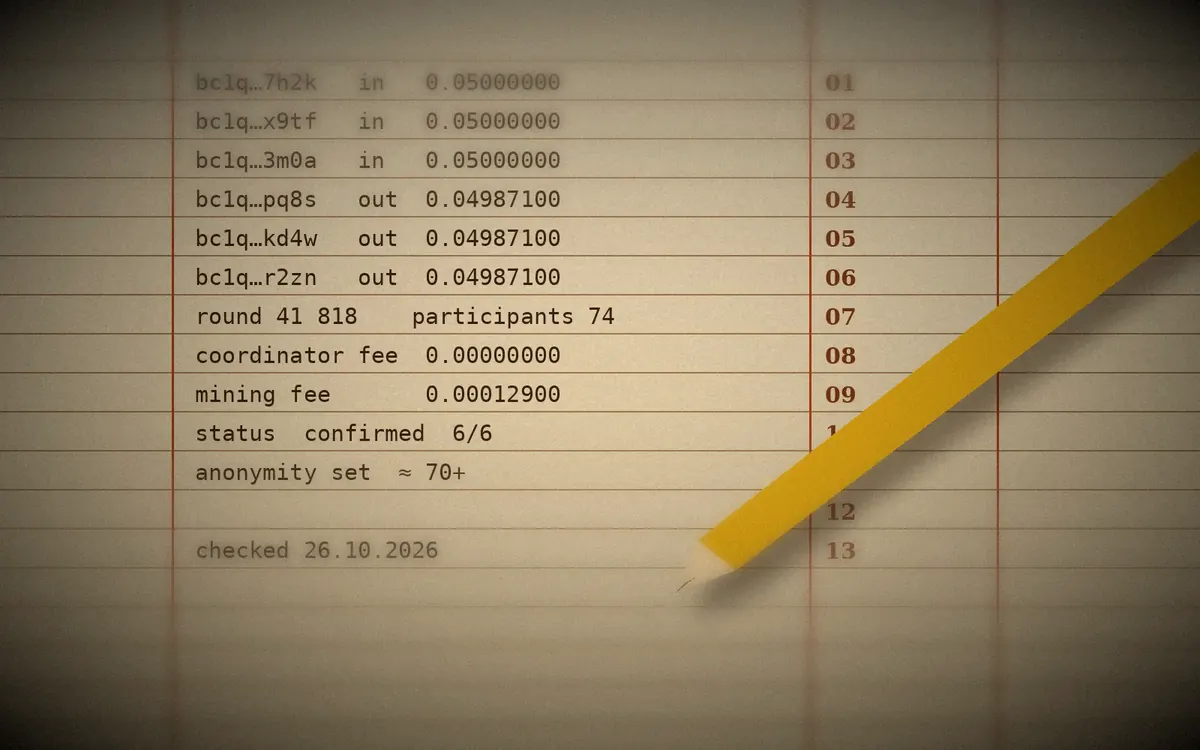
Headline percentages mislead. A flat 1% on a hosted service can beat a CoinJoin wallet during a mempool spike, because every round pays on-chain fees for dozens of inputs. What buys privacy is the anonymity set, the number of identical outputs yours hides among.
Timing matters too. Outputs spread over hours break the trick of matching what went in with what came out minutes later, which is why any honest crypto mixers list favours tools that let you set the delay.
FAQ
Quick answers
Is coin mixing legal in 2026?
It is not banned outright in the US or most of Europe, and in October FinCEN shelved its plan to single out mixing. Some countries restrict it, so check local law first.
Which option costs least?
JoinMarket usually does. In a congested mempool a flat-fee hosted service can undercut a large CoinJoin round.
How long does mixing take?
A CoinJoin round takes minutes to an hour. Hosted services return coins after the delay you choose, from about an hour to several days.